
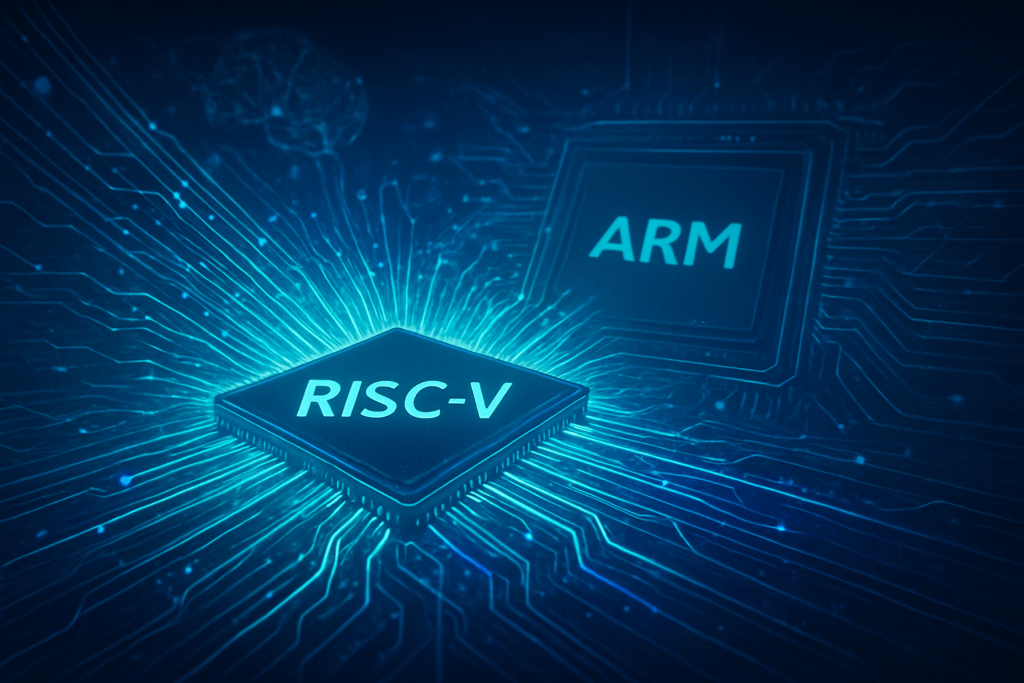
The chip industry has a permission problem hiding under all the talk about speed. RISC V matters because it turns the instruction set, the basic contract between software and hardware, into something more like shared road rules than private toll roads. That does not make chip design easy. It changes who gets to try. For U.S. founders, hardware engineers, university labs, defense suppliers, automakers, and AI device makers, the bigger question is no longer whether Intel or Arm can make strong processors. They can. The question is whether every new product should begin by renting someone else’s foundation. Readers following the broader technology market through digital business coverage can see why this matters beyond engineering teams. The open source processor architecture is pulling chip strategy into boardrooms, procurement meetings, and national policy. Its official standards body describes the ISA as a customizable open standard platform, and its ratified specifications are free and publicly available.
The Architecture Fight Is a Fight Over Control
Processor architecture sounds like a lab topic until a company has to ship ten million devices and live with the bill for years. A thermostat maker in Texas, an auto supplier in Michigan, or a robotics startup in Pittsburgh may not need a laptop-class CPU. It may need a small, low-power controller that behaves in a certain way, wakes fast, handles sensor data, and survives a long support cycle. That is where the old market story starts to crack. The contest is less about one chip beating another in a benchmark and more about who owns the map before the product is even designed. Control is not romantic here. It is the difference between waiting on a vendor roadmap and building the part your product needed six months ago.
Why an Open Standard ISA Feels Different From a Product
An instruction set is not the processor itself. It is the language the processor understands. Arm sells access to a family of designs and related rights. Intel has long tied its strength to x86 chips, manufacturing know-how, and a software base built over decades. The open standard ISA takes a different path. It gives design teams a common language, then lets them build their own hardware around it.
That distinction matters. A U.S. company building a smart meter does not want to redesign its software stack every time it changes silicon vendors. A university lab teaching chip design does not want the first lesson to be a licensing negotiation. An open source processor architecture can lower the wall at the start, which is often where small teams quit. The official standards work also gives engineers a public place to check what is stable, what is still under development, and where their own design choices may fit.
The counterintuitive part is that openness can make some buyers more loyal, not less. Once engineers write tools, test benches, firmware, and internal knowledge around a shared ISA, they may stay inside that world for years. The lock-in moves away from a single vendor and toward the team’s own work. That kind of lock-in feels different because the buyer helped create it.
What Proprietary Chips Still Do Better
None of this means Arm or Intel suddenly lose their edge. Mature chip families come with proven development tools, supplier relationships, support teams, operating system work, and a long record of field failures already fixed. That boring history is worth money. In medical devices, factory systems, and vehicles, boring often wins. A procurement officer may prefer the chip that has shipped for years over the one that looks cleaner on a whiteboard.
A laptop buyer in Ohio does not care whether the CPU’s instruction set is open. The machine has to boot fast, run Windows apps, handle video calls, and last through a workday. Intel still benefits from that huge software base. Arm still benefits from its power record in phones and its deep place in mobile design. Those advantages are not marketing fog. They are years of dull engineering work packed into a product line.
The non-obvious lesson is that the open standard does not need to win the visible consumer market first. It can grow from the edges: controllers, security chips, storage devices, AI accelerators, and custom parts hidden inside larger systems. By the time shoppers notice, the architecture may already be inside products they use every day. Quiet adoption can be more durable than a splashy launch.
Why RISC V Changes the Price of Permission
The biggest cost in chips is not always silicon. Often, it is the set of choices a company cannot make. Proprietary architectures can be worth paying for, yet they come with boundaries. You may face license terms, design limits, roadmap risk, or a business model that changes after your product plan is already built. The open standard changes that starting point. It does not hand you a finished chip. It gives you room to shape one. That room can decide whether a product becomes a true platform or stays trapped inside someone else’s plan.
Lower License Pressure Does Not Mean Free Chips
A common mistake is to treat royalty-free architecture as a free processor. That is not how hardware works. A team still needs engineers, verification, physical design, security review, firmware, compilers, test chips, packaging, and manufacturing partners. One bug in silicon can burn months and cash in a way software teams rarely understand. The bill moves from permission to execution.
Still, removing one gate can change the math. A startup making an industrial sensor can spend more time on battery life or secure boot instead of shaping the design around a license it cannot bend. A defense contractor can ask for a processor extension suited to a narrow mission. A university spinout can build a demo without starting from a closed commercial core. For small teams, that early freedom can mean the project survives long enough to earn serious review.
That is why the chip design ecosystem matters as much as the ISA. The value is not only in the rulebook. It is in the tools, engineers, IP blocks, operating systems, and boards that gather around it. A cheap architecture with a weak support base is still expensive in the end. The winning version will be the one that makes ordinary engineering tasks feel less risky, not the one with the loudest slogan.
Where Small Teams Can Build Around the Open Source Processor Architecture
The best early markets are often unglamorous. Think warehouse scanners, motor controllers, smart grid boxes, point-of-sale terminals, drone subsystems, and edge AI sensors. These products need control, long life, and cost discipline more than headline speed. They also ship in enough volume for a custom chip decision to matter. A few cents saved on power, memory, or board space can become real money when the product keeps selling.
For a practical example, consider a U.S. company building farm sensors for irrigation. It may need a processor that sleeps most of the day, wakes when soil readings change, encrypts data, and sends a short message through a low-power network. A general chip can do that. A tailored chip may do it with less energy and less waste. The customer never sees the ISA, but the farmer sees longer battery life and fewer field visits.
There is a quiet twist here. The smallest chip may be the most strategic one. A tiny controller buried in millions of devices can create more long-term dependence than a flashy server CPU. Readers planning related content can connect this point to semiconductor supply chain strategy, because architecture choice often shapes sourcing risk before a purchase order exists. Once a product line grows around a controller, changing it feels like changing the plumbing inside a finished building.
The Real Pressure on ARM and Intel Dominance
ARM and Intel dominance was built on different kinds of trust. Intel earned trust through decades of PC and server compatibility. Arm earned it by becoming the default answer for low-power mobile computing. The open standard does not erase that trust. It asks buyers a sharper question: do you need the old default, or do you need control over a narrower job? In a market where cars, appliances, and factory machines now behave like computers, that question keeps appearing in places it never used to show up.
Custom Silicon Is Turning Buyers Into Builders
Large technology firms no longer see processors as neutral parts. Cloud providers design chips for their own data centers. Phone makers tune silicon to cameras, AI features, and battery goals. Automakers want more control over electronic platforms because software now shapes the driving experience. Once buyers become builders, a flexible ISA becomes more attractive. The buyer is not shopping for a chip anymore. It is shaping a compute layer around a business model.
The Reuters report on SiFive adopting Nvidia’s NVLink technology shows why this shift matters. SiFive said its future designs will connect the open-standard CPU path to Nvidia AI chips at speeds comparable with Intel or Arm-based options, though those products are not expected before 2027 or later. That does not prove a takeover. It proves the conversation has moved into serious infrastructure. AI data centers care about the links between chips as much as the cores inside them.
The surprising part is that Arm may feel more pressure than Intel in some custom markets. Intel’s x86 base is heavy, old, and tied to huge software habits. Arm’s appeal has often included licensing flexibility. When another architecture offers a different kind of design freedom, Arm has to defend not only performance, but also its business terms. That is a harder defense when customers have their own silicon teams.
Software Support Is the Slow Part Nobody Can Skip
Hardware people love clean diagrams. Software people inherit the mess. A processor architecture becomes useful only when compilers, debuggers, operating systems, drivers, security tools, and developer habits catch up. This is where x86 and Arm still have deep moats. A mature toolchain can save more money than a lower license cost if the launch deadline is tight.
A company can design a brilliant chip and still lose because the camera driver breaks, the machine learning library is immature, or the security patch process is unclear. U.S. device makers know this pain. The chip is only one part of the product. The update system, cloud connection, app layer, and service contract all have to survive. Nobody wants to explain to a retail partner that a firmware issue delayed a holiday launch.
That makes the next phase less dramatic than many headlines suggest. The open ISA will not march across every market at the same pace. It will win where software stacks are narrow, controlled, or rebuilt for a special job. It will wait where broad app support decides the sale. Slow adoption is not failure here. It is how serious hardware markets absorb a new base layer without breaking everything above it.
Why the United States Should Treat the Open ISA as Strategy
The U.S. semiconductor debate often starts with fabs, subsidies, and export controls. Those are real issues, but they do not cover the full stack. Architecture sits closer to the idea layer. It shapes what students learn, what startups can test, what defense labs can adapt, and how firms join standards work. If America wants more chip design talent, the country needs more paths into chip design. The factory matters. The design bench matters too.
Policy Risk Comes From Absence, Not Participation
Some U.S. policymakers worry that an open chip standard could help rivals, including China. The concern is not silly. Standards can spread knowledge, and chip capability has national security weight. Yet the harder question is what happens if U.S. companies step back while others keep writing the rules. Standards do not pause because one country grows nervous.
CSIS argues that U.S. disengagement would not stop global development and could leave American firms with less influence over the standard’s direction. It also notes that the standard itself does not force companies to reveal their private implementation IP. CSET has framed direct regulation as legally difficult and potentially harmful, since the standard is international and open by design. That is a different view from the instinct to wall off every sensitive area.
That is the counterintuitive policy lesson. Participation can be safer than distance. If U.S. engineers, universities, and companies stay active, they can shape security profiles, tooling, verification methods, and best practices. Walking away may feel tough. It may also hand the pen to someone else. In standards work, silence is not neutral.
The Next Chip Design Ecosystem Will Reward Builders Who Stay Close
The CHIPS and Science Act put major federal weight behind U.S. semiconductor research, development, manufacturing, and workforce programs. NIST describes CHIPS for America as a Commerce Department effort tied to strengthening the U.S. position in semiconductor research, development, and manufacturing. That money matters, but money alone does not create enough designers. Talent grows through repetition, mistakes, and access to real tools.
A healthier chip design ecosystem needs students taping out simple chips, startups testing narrow ideas, and mid-size firms choosing custom silicon without feeling locked out. Open instruction sets help because they make teaching and early prototyping less dependent on permission. The first win may be a classroom board, not a billion-dollar processor. That small board can teach timing, verification, firmware, and failure in a way slides never can.
For U.S. businesses, the practical move is not to bet the company on one architecture slogan. Map the product. If you need mass-market app support, stay with mature platforms. If you need long-life control, custom security, low power, or supply flexibility, study the open standard path early. That thinking pairs well with AI hardware cost planning, because processor choice now shapes model deployment costs at the edge. The best teams will keep both options open until the product tells them which one earns its place.
Conclusion
The processor market is not turning into a simple winner-takes-all race. That is the wrong picture. The better picture is a widening set of roads. Intel will remain hard to replace where x86 compatibility carries the product. Arm will remain strong where power, tools, and mobile history matter. But the rise of RISC V gives U.S. teams another way to think about ownership before they design the device. It makes architecture a business choice, not only an engineering choice. The near future will reward calm judgment over tribal loyalty. Some products should stay on proven silicon because the software risk is too high. Others should explore open designs because the old permission model steals too much room from the product. The winners will not be the loudest believers in open hardware. They will be the teams that know where control pays for itself and where a mature vendor is still the safer call. For founders, product leaders, and technical buyers, the next smart step is simple: ask who owns your processor roadmap before the roadmap owns you.
Frequently Asked Questions
What makes this open processor standard different from Arm?
Arm is a company with licensed designs and business terms. The open standard is a shared instruction set that design teams can implement without the same ISA licensing model. That does not remove engineering cost, but it changes who controls the starting point.
Is the open source processor architecture ready for laptops?
For most U.S. laptop buyers, not yet in a broad mainstream sense. App support, operating system polish, drivers, and retail confidence still favor x86 and Arm machines. The architecture is stronger today in embedded systems, custom chips, research boards, and special-purpose hardware.
Will this architecture replace Intel processors in PCs?
A full replacement is unlikely soon. Intel’s strength comes from decades of x86 software support, enterprise habits, and PC vendor ties. The open ISA is more likely to grow first in hidden controllers, edge devices, accelerators, and narrow systems where custom design matters more.
Why are startups interested in open chip standards?
Startups like the freedom to design around a specific product need without beginning from a closed licensing path. That can help in low-power devices, security hardware, robotics, and sensors. The tradeoff is that the team must still handle tools, testing, and support.
Does an open ISA make chips less secure?
No, openness alone does not make a chip weak. Security depends on the actual implementation, verification, firmware, supply chain, and update process. An open standard can even help review and teaching, but careless hardware design can fail under any architecture.
How does this affect ARM and Intel dominance in America?
It adds pressure where buyers want more control over cost, customization, and supply choices. Arm and Intel still have strong positions, yet U.S. companies now have a credible third path for some designs. That changes negotiations even when firms stay with older platforms.
What industries could adopt this architecture first?
Industrial equipment, automotive subsystems, smart energy devices, defense electronics, storage, wearables, and edge AI hardware are strong candidates. These markets often care more about control, power use, and long support cycles than broad consumer app compatibility.
Should a U.S. business choose this architecture for a new device?
Choose it when custom control, long product life, low power, or supply flexibility outweigh the comfort of mature vendor platforms. Avoid it when your product depends on broad software support, fast certification, or a team with little hardware design experience.